
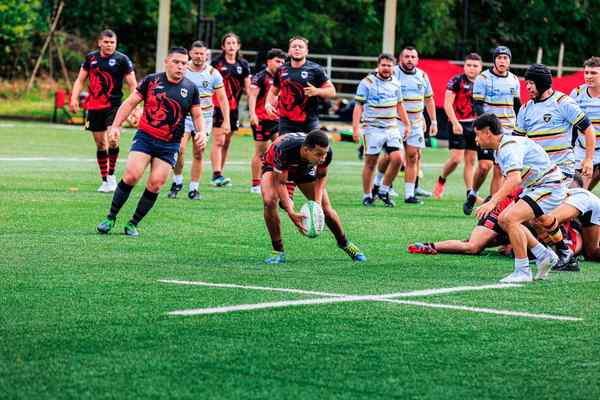
At first glance, rugby union and rugby league can look almost identical. Both are played on a rectangular field with an oval ball, both involve tackling, and both reward teams for carrying the ball across the opposition’s try line. Watch for a little longer, however, and the differences become much easier to spot.
The two sports developed from the same rugby tradition but evolved into separate codes with different rules, tactics and styles of play. Rugby union tends to feature more competition for possession, structured set pieces and tactical kicking. Rugby league is generally faster, more continuous and built around a limited number of tackles.
For anyone new to the sport, this guide provides the main rugby codes explained clearly, from team sizes and possession rules to tackles, scrums and the difference in rugby scoring.
What Is the Main Difference Between Rugby Union and Rugby League?
The biggest difference is how possession works after a tackle. In rugby union, a tackled player must release the ball, allowing players from both teams to compete for it through a ruck. Possession can therefore change at almost any breakdown.
Under standard rugby league rules, the attacking team keeps possession after a tackle and restarts play with a play-the-ball. It can complete a set of six tackles before possession is handed to the opposition. This creates a more predictable attacking structure and encourages teams to make as much ground as possible during each set.
This single distinction influences nearly everything else. Union teams spend more time fighting for possession, while league teams focus on using their limited tackles efficiently.
Team Sizes: 15 Players vs 13 Players
A rugby union team has 15 players on the field. These are divided into eight forwards and seven backs. The forwards are usually responsible for scrums, lineouts, close-range carries and physical contests at the breakdown. The backs generally provide more speed, kicking ability and attacking creativity in open space.
A rugby league team has 13 players: six forwards and seven backs. Because there are fewer players covering a field of a similar size, league often provides more space for runners. Defensive lines must move quickly and remain organised, particularly after several consecutive tackles.
The missing flankers found in union are one reason league formations can appear more open. Every player still has a defined role, but modern rugby league also expects forwards to run, pass and defend with considerable mobility.
How Tackles and Possession Work
Rugby Union Tackles and Rucks
According to rugby union rules, a tackle does not automatically allow the attacking team to keep the ball. Once the ball carrier is brought to ground, the player must release or present the ball. Teammates may protect it, while defenders can attempt to win possession legally.
This contest often forms a ruck, where players bind over the ball and try to drive the opposition away. Rucks are a central feature of union and can make the game feel more tactical and unpredictable. A team may build a long attack, only to lose possession because of a strong defensive turnover.
Rugby League Tackles and the Six-Tackle Rule
In rugby league, the referee counts each completed tackle. After being tackled, the ball carrier stands, places the ball on the ground and rolls it backwards with the foot. A teammate, usually the dummy-half, then collects it and continues the attack.
The attacking side receives six tackles in most circumstances. Teams commonly use the first few tackles to gain territory before passing more widely or kicking on the final tackle. If a player is tackled after the sixth without producing a kick or another legal outcome, possession changes hands.
This system gives league its distinctive rhythm. Attacks move through repeated phases, while the defence retreats and resets after every tackle.
Scrums and Lineouts
Scrums are important in both sports, but they serve different purposes. Rugby union scrums are heavily contested set pieces involving eight forwards from each team. They can be used to win penalties, create attacking platforms and establish physical control.
Rugby league scrums involve six players from each side and are primarily used to restart play after certain infringements or errors. They are much less focused on pushing power than union scrums. The greater tactical value often comes from temporarily gathering forwards in one area, creating space for the backs.
Lineouts are another major difference. Rugby union uses lineouts to restart play after the ball crosses the touchline. Players can be lifted into the air to catch a throw from the touchline. Rugby league does not use lineouts. Play usually restarts with a scrum or another designated restart, depending on how the ball left the field.
The Difference in Rugby Scoring
Both codes reward tries and successful kicks, but the points awarded are not identical. In rugby union, a try is worth five points. The conversion that follows is worth two points. A successful penalty goal or drop goal is normally worth three points.
In rugby league, a try is worth four points and a conversion is worth two. A penalty goal is generally worth two points, while a standard drop goal, often called a field goal, is worth one point. Some competitions have introduced variations for long-range field goals, but the traditional one-point value remains the basic rule.
This difference in rugby scoring affects team strategy. Union sides may regularly take penalty kicks because three points can be valuable in a close match. League teams are more likely to continue attacking for a try, although a one-point field goal can decide a tight game during the final minutes.
Playing Style and Match Tempo
Rugby union often involves a mixture of sustained possession, tactical territory, set-piece battles and contests at the breakdown. Matches can change direction quickly because either team may win the ball at a ruck, scrum or lineout.
League tends to have a more consistent end-to-end flow. The six-tackle system produces clear periods of attack and defence, with teams alternating possession more regularly. Players usually retreat a set distance after each tackle, giving attackers room to build momentum.
That does not mean one code is automatically faster or more physical than the other. Both demand strength, endurance, skill and tactical awareness. They simply test those qualities in different ways. Union places greater emphasis on competing for possession, while league places greater emphasis on territory, tackle efficiency and organised defensive lines.
Kicking Strategies in Each Code
Kicking is essential in both forms of rugby, but it is used differently. In union, teams frequently kick to gain territory, find touch, relieve defensive pressure or challenge opponents in the air. Because lineouts can provide another opportunity to contest possession, kicking the ball out can be a deliberate tactical choice.
League teams commonly kick near the end of a six-tackle set. A low kick into the in-goal area may create a try-scoring opportunity, while a high kick can pressure a defending catcher. Long kicks are also used to force the opposition to begin its next set close to its own try line.
Which Code Is Easier for Beginners to Understand?
Many newcomers find rugby league easier to follow initially because the tackle count provides a visible structure. The attacking team has six opportunities to advance before possession changes, making it relatively simple to understand what each side is trying to achieve.
Rugby union has more situations where possession can be contested, along with detailed laws governing rucks, mauls, scrums and lineouts. It may take longer to understand why a referee has awarded a penalty. Once those principles become familiar, however, the tactical depth becomes one of union’s biggest attractions.
The best way to learn either sport is to watch a full match while paying attention to possession. In league, count the tackles. In union, watch what happens immediately after the ball carrier goes to ground.
Frequently Asked Questions
Why did rugby split into union and league?
The split occurred in England in 1895 following disagreements over player payments. Northern clubs wanted to compensate working-class players for wages lost while playing. Those clubs formed a separate organisation that eventually developed rugby league, while rugby union remained officially amateur for much of the following century.
Can rugby union players switch to rugby league?
Yes. Players have moved between the two codes throughout their history. However, switching requires adjustment because tackling, defensive positioning, set pieces and possession structures differ. Skills such as passing, running, kicking and reading space are valuable in both.
Is rugby league more physical than rugby union?
Both are highly physical sports. Rugby league features frequent tackles, repeated defensive efforts and powerful running. Rugby union adds intense contests in rucks, mauls, scrums and lineouts. The physical demands are different rather than one code being universally tougher.
Do rugby union and rugby league use the same field?
The fields are broadly similar in shape and length, but their markings and dimensions are not exactly the same. Rugby league fields prominently display distance lines that help teams and spectators judge territory during a six-tackle set.
Understanding the Two Rugby Codes
The simplest way to remember the rugby union vs rugby league differences is to focus on players and possession. Union has 15 players and allows both teams to contest the ball after a tackle. League has 13 players and gives the attacking side a set of six tackles.
From there, the other differences become clearer. Union includes contested scrums, lineouts and five-point tries. League uses play-the-balls, less-contested scrums and four-point tries. Both codes share the same foundations, but each has developed its own pace, tactics and identity.
Whether you prefer the set-piece battles of union or the structured speed of league, understanding these basic rules makes either version of rugby far easier—and far more enjoyable—to watch.