
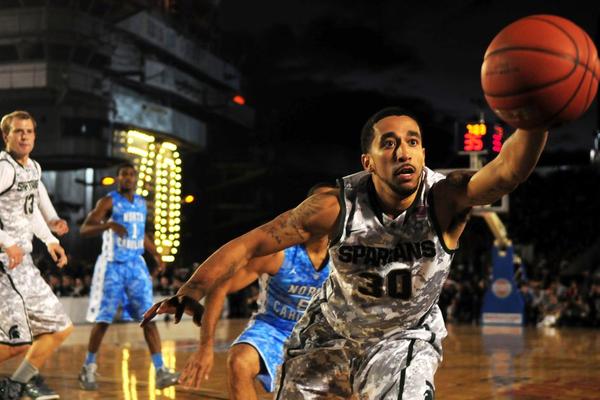
If you watch an NBA game one night and an NCAA men’s game the next, the sport looks familiar but the rhythm can feel surprisingly different. The baskets are the same height, the scoring system is familiar, and both games use five players per side, yet several timing, foul and possession rules change how teams attack and defend. For UK fans switching between leagues, understanding these NCAA vs NBA rules differences makes college basketball much easier to follow.
This comparison focuses on NCAA men’s basketball. The women’s college game has some different rules of its own, including four quarters rather than two halves, so “NCAA rules” are not identical across both competitions.
Game length: two halves in NCAA, four quarters in the NBA
NCAA men’s games are 40 minutes long, split into two 20-minute halves. NBA games last 48 minutes, divided into four 12-minute quarters. Both use five-minute overtime periods when the score is tied.
This is one of the easiest basketball rule differences to notice on television. College men have one halftime break between the two main periods, while the NBA resets at the end of every quarter. The NCAA has discussed a possible move to quarters, but men’s basketball remains a two-half game for 2026-27.
The shot clock is longer in college basketball
The NCAA shot clock is 30 seconds, while the NBA uses a 24-second clock. That six-second gap gives college offences more time to run sets, reverse the ball and work for a preferred matchup.
The reset after an offensive rebound also differs. In NCAA men’s basketball, the clock generally resets to 20 seconds when the offence regains the ball after a shot that hits the rim. In the NBA, the equivalent reset is 14 seconds. Watch an offensive rebound in each league and the difference becomes obvious: the NBA team has to move into its next action much faster.
Teams have different amounts of time to cross half court
NBA rules require a team to advance the ball from the backcourt within eight seconds. NCAA men’s basketball uses a 10-second rule. For 2026-27, NCAA officials are instructed to recognise that violation when a 30-second shot clock reaches 19 seconds, reflecting the way tenths of a second are displayed and administered.
The practical effect is modest but noticeable. NBA ball-handlers are under slightly more pressure to get organised quickly after gaining possession, especially against a full-court press.
The three-point line is farther away in the NBA
The NBA three-point arc reaches 23 feet 9 inches from the centre of the basket above the break, with 22-foot corner threes. The NCAA men’s arc is 22 feet 1¾ inches, with the straight corner section slightly closer.
That changes spacing. NBA defenders often have more ground to cover between the paint and a shooter above the break, while college defences can pack the floor a little more tightly. An NCAA basketball court dimensions guide is a useful next read if you want to compare the markings in more detail.
Players foul out sooner in NCAA basketball
An NCAA men’s player is disqualified after five fouls. In the NBA, a player normally fouls out after six personal fouls. The difference broadly matches game length: college games are shorter, so players have one fewer foul available.
The team-bonus systems also differ. In NCAA men’s basketball, the seventh team foul of a half puts the opponent into the one-and-one bonus for qualifying common fouls, while the 10th team foul brings two free throws. In the NBA, teams can commit four team fouls in a regulation quarter before the standard penalty applies; common team fouls beyond that generally produce two free throws, with separate late-quarter provisions.
This matters late in close games. A college team sitting on six team fouls is one whistle away from giving the opponent a bonus opportunity, even if several minutes remain in the half.
The NBA has a defensive three-second rule
Both levels restrict offensive players from staying in the lane too long, but the NBA also has a defensive three-second rule. An NBA defender cannot remain in the lane for more than three seconds without actively guarding an opponent, subject to the rule’s exceptions. A violation gives the offence a technical free throw and possession.
NCAA men’s basketball does not use the same defensive three-second restriction. That gives college teams more freedom to keep a rim protector around the paint, one reason packed-in and zone-style defences can look different from NBA schemes.
Held balls and clock stoppages work differently
After the opening tip, NCAA basketball commonly resolves held-ball situations with the alternating-possession arrow. The NBA uses jump-ball procedures instead. A basketball rules explained guide can help connect this difference with other possession calls such as travelling and out-of-bounds decisions.
There is also a timing difference after made baskets. In NCAA men’s basketball, the game clock stops after a made basket during the final minute of the second half and overtime. In the NBA, it stops after made field goals during the final minute of the first three quarters and the final two minutes of the fourth quarter and overtime. That is one reason a close NBA finish can take much longer in real time than the scoreboard suggests.
Which differences matter most when you are watching?
For a new UK viewer, three rules explain most of the change in feel: NCAA men play 40 minutes in halves, use a 30-second shot clock and disqualify players on five fouls. Add the 10-second backcourt count and the closer three-point line, and the college game becomes much easier to read.
If you switch between broadcasts, glance at the period format, shot clock and team-foul display first. Those three clues usually tell you which rule set is shaping the action. An NBA rules beginner guide is a natural follow-up if you want a deeper explanation of the professional game.
FAQ
Is the NCAA shot clock the same as the NBA shot clock?
No. NCAA men’s basketball uses a 30-second shot clock, while the NBA uses 24 seconds. Offensive-rebound resets also differ, with 20 seconds in NCAA men’s play and 14 seconds in the NBA.
Does NCAA basketball use quarters like the NBA?
NCAA men’s basketball uses two 20-minute halves. The NBA uses four 12-minute quarters. NCAA women’s basketball uses four 10-minute quarters.
How many fouls does it take to foul out?
In NCAA men’s basketball, a player is disqualified after five fouls. In the NBA, the normal limit is six personal fouls.
Why does NBA basketball often look more spread out?
Several rules contribute, especially the longer NBA three-point line and the defensive three-second restriction. Together, they can create more space around the lane and force defenders to make quicker decisions away from the basket.
The main takeaway
NCAA and NBA basketball share the same core game, but their rules create distinct styles. College men have shorter games, longer possessions, a closer three-point line, a five-foul limit and more freedom for defenders to protect the paint. The NBA uses longer games, a faster shot clock and rules that encourage wider spacing and quicker transitions. Once those differences are familiar, switching between March Madness and an NBA broadcast becomes far less confusing.