
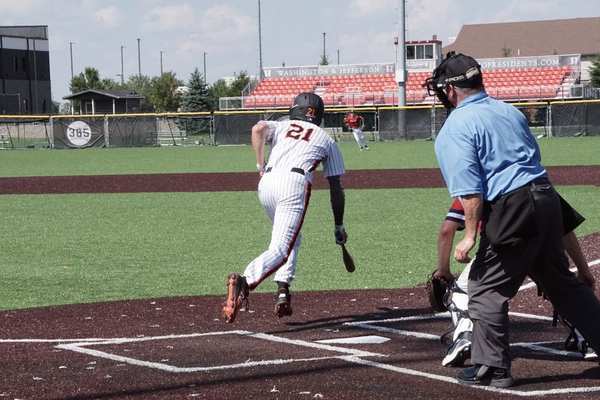
The strike zone looks simple on a broadcast: a box appears over home plate, the pitch arrives, and the umpire calls a ball or a strike. In a real game, the zone has height and depth, the batter’s body helps define its traditional limits, and a moving baseball only needs to catch part of the zone to qualify as a strike. That is why borderline pitches create so much debate.
Understanding the baseball strike zone also makes an at-bat easier to follow. The count changes what a pitcher is willing to throw, what a hitter is willing to chase, and how much risk each side can take.
What Is the Strike Zone?
In Major League Baseball, the traditional rulebook strike zone is the space over home plate between a lower boundary just below the batter’s kneecap and an upper boundary at the midpoint between the top of the shoulders and the top of the uniform pants. Its height is judged from the batter’s stance as the batter is prepared to swing.
Home plate is 17 inches wide, but the ball does not have to pass through its middle. If any part of a pitch crosses any part of the plate while also passing through the vertical limits of the zone, it can be called a strike. A pitch that looks mostly outside may therefore still clip the edge.
The zone is not simply a flat box at the front of the plate. A pitch travels through space above home plate, and breaking pitches can move sharply as they arrive.
How Balls and Strikes Are Called
The home-plate umpire makes the initial ball-or-strike decision on pitches the batter does not put into play. A pitch in the zone that is taken is a called strike. A taken pitch outside the zone is normally a ball. A swing and miss is also a strike regardless of where the pitch crosses.
Foul balls add another wrinkle. A foul normally counts as a strike when the batter has fewer than two strikes, but an ordinary foul ball does not become strike three. A foul bunt with two strikes can retire the batter, while a legally caught foul tip can also be strike three.
Why a Borderline Pitch Can Look Wrong
Several factors can make an umpire strike zone appear inconsistent. The batter’s height and stance affect the traditional vertical zone. The catcher’s receiving position can change how a pitch looks. Television strike-zone graphics are viewing aids rather than the rule itself, and camera perspective can distort how close a pitch appears to an edge.
There is also human judgment. Plate umpires track a fast-moving pitch while watching the batter and catcher. The official zone is not supposed to become wider in a pitcher’s count or smaller in a hitter’s count.
How MLB’s 2026 ABS Challenge System Works
Major League Baseball introduced its Automated Ball-Strike Challenge System for the 2026 season. Human plate umpires still make the original calls, but a batter, catcher or pitcher may immediately challenge a ball-or-strike decision. Each team begins with two challenges and keeps a challenge when it is successful.
The automated review uses a standardized zone based on the player’s measured height. MLB’s ABS zone is 17 inches wide, with the top set at 53.5% of the player’s measured height and the bottom at 27%. The system evaluates the pitch at the midpoint of home plate, and any part of the ball touching the automated zone is a strike.
The umpire still owns the live call, while selected close pitches can be checked against the automated zone. That is different from having a computer call every pitch.
Baseball Count Explained: Why the Count Changes Strategy
The count is written with balls first and strikes second. A 2-1 count means two balls and one strike. Four balls generally give the batter a walk, while three strikes produce a strikeout. A 3-2 count is called a full count because the next uncontacted pitch can easily end the plate appearance with either a walk or a strikeout.
Counts shape strategy without changing the legal strike zone. At 0-2, the pitcher has room to throw a breaking ball just below or outside the zone, hoping the hitter will chase. At 3-0, the hitter can be highly selective because one more ball means a walk, while the pitcher has less margin for missing the zone.
For a practical example, imagine a 1-2 count with a right-handed pitcher facing a right-handed hitter. The pitcher throws a slider that starts near the outside edge and breaks down and away. If the hitter takes it and it misses, the count becomes 2-2. If the hitter chases and misses, the at-bat is over. The strike zone did not move; the pressure created by the count changed the decision.
How Pitchers and Hitters Use the Edges
Good pitchers rarely treat the middle of the zone as the goal. They work the borders, change eye level, and pair pitches so that a strike and a tempting ball can look similar out of the hand. Learning pitching basics or how breaking balls move helps explain why command around the edges is so valuable.
Hitters try to do the opposite: shrink the zone to pitches they can drive. Early in the count, a batter may ignore a marginal strike in a weak hitting location. With two strikes, that same batter usually protects more of the plate because taking a close strike could end the at-bat. A baseball rules for beginners guide can help connect these choices to walks, strikeouts and plate appearances.
Frequently Asked Questions
Does the whole baseball have to be inside the strike zone?
No. A called strike can be awarded when any part of the ball catches any part of the legal zone. Borderline pitches do not need to be centered over the plate.
Does the strike zone change with the count?
No. The legal zone does not expand at 0-2 or shrink at 3-0. What changes is strategy: pitchers may aim farther toward the edges, and hitters may become more or less selective.
Is the TV strike-zone box official?
No. Broadcast graphics are useful guides, but they are not the authority making the live call. In 2026 MLB games, eligible close calls can instead be challenged through the ABS system.
Can a batter create a smaller strike zone by crouching?
Under the traditional definition, the zone is judged from the batter’s stance as prepared to swing, so an exaggerated temporary crouch does not simply guarantee a smaller zone. MLB’s ABS challenge system uses standardized player measurements for its automated review.
Making Sense of the Zone
The easiest way to read an at-bat is to separate the rule from the strategy. The strike zone defines where a taken pitch should be a strike, while the count determines how aggressively the pitcher and hitter approach that space. Human judgment, pitch movement and viewing angles can make the borders look uncertain, and MLB’s 2026 challenge system now provides a limited automated check on some close calls. Follow the zone, then follow the count, and each pitch becomes easier to understand.