
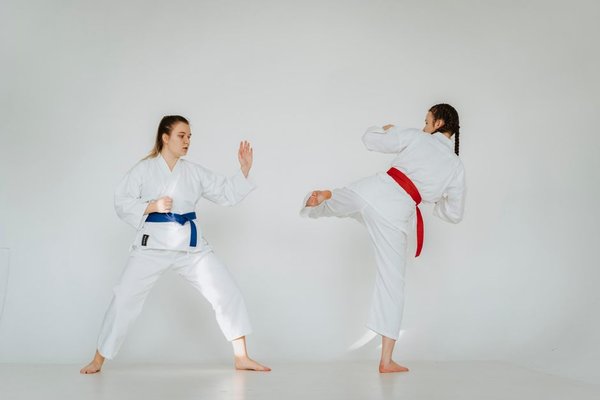
Walk into two karate dojos and you might see students practising the same punch in noticeably different ways. One group takes long, grounded steps; another works at close range, turning the body while controlling the breath. Neither is necessarily doing karate “wrong.” Different schools preserve distinct approaches to movement, distance and training.
The best-known types of karate share Okinawan roots, but their methods developed along different paths. With the major karate styles explained side by side, it becomes easier to understand what Shotokan, Goju-Ryu, Wado-Ryu and Shito-Ryu teach—and why the instructor matters as much as the style.
What makes one karate style different from another?
Traditional karate commonly includes kihon (fundamentals), kata (set sequences of techniques) and kumite (partner practice or sparring). Styles differ in their preferred stances, ways of generating power, kata and tactical emphasis.
A long stance in a basic drill does not mean a practitioner must fight from that position. Likewise, a style known for circular defences still teaches straight punches. Each school is a framework for learning, not a collection of exclusive moves.
Shotokan karate: distance, structure and decisive technique
Developed through Gichin Funakoshi’s teaching and that of his successors in Japan, Shotokan is recognised for strong fundamentals, direct movement and often deep, extended stances in formal practice. Students refine alignment, hip rotation, timing and the link between footwork and striking.
Shotokan karate classes commonly balance kihon, kata and kumite. The Heian kata introduce foundational coordination; more complex forms follow. In sparring, many schools emphasise managing distance and entering at the right moment with a controlled, committed technique.
Its crisp movements make progress visible, but a low stance is not an instruction to stay rigid. Good instruction gradually connects structured basics to adaptable movement.
Goju-Ryu karate: hard and soft working together
Chojun Miyagi developed Goju-Ryu from Okinawan Naha-te traditions. Its name means “hard-soft school,” describing firm, direct actions alongside yielding, rounded responses. Strength and relaxation are not opposites here: both serve a purpose.
Goju ryu karate often emphasises close-range control, stable positions, breathing and conditioning. Sanchin kata explores coordinated posture, tension, movement and breath; Tensho develops softer, flowing hand actions. Conditioning intensity varies between organisations and instructors.
For someone curious about how structure works at short distance, Goju-Ryu offers a distinctive perspective. Yet it is not exclusively close-range, just as Shotokan is not exclusively long-range.
Wado-Ryu: positioning before collision
Wado-Ryu was founded by Hironori Otsuka, who brought Japanese jujutsu experience to his karate practice. Rather than always meeting an attack with a firm block, Wado-Ryu is especially associated with body shifting, evasion and efficient repositioning.
Students learn to move as an attack arrives, helping it miss or lose effectiveness while opening a chance to counter. Partner exercises develop timing and angle. These movements can look understated, but their precision takes considerable practice.
Wado-Ryu shows that karate does not require two people to exchange force head-on. Its principles reward economical movement over elaborate display.
Shito-Ryu: a wide-ranging kata tradition
Kenwa Mabuni established Shito-Ryu by drawing on teachings associated with Anko Itosu and Kanryo Higaonna. This heritage joins influences linked to Shuri-te and Naha-te, giving the style a notably broad selection of kata and movement qualities.
A Shito-Ryu class may practise sharp transitions in one form and rooted, controlled actions in another. The variety helps students explore why techniques change with distance and purpose.
Beginners are not expected to master dozens of kata immediately. Responsible teachers introduce material progressively and explain its applications instead of merely increasing the number of patterns students memorise.
Other important karate traditions
The four prominent schools are not all karate has to offer. Okinawan Shorin-Ryu includes lineages that value agile movement and traditional kata. Uechi-Ryu has distinctive forms and conditioning, with historical links to Chinese martial arts.
Kyokushin, founded by Masutatsu Oyama, is particularly associated with demanding physical training and full-contact, knockdown-style competition. Its sparring conventions differ from controlled point tournaments. Organisations within any style may follow different syllabuses.
Stances, kata and sparring: what should you compare?
Stances and movement
Notice whether long or low positions appear mainly in basic exercises or in partner drills too. Shotokan often highlights extended positions in fundamentals; Goju-Ryu frequently uses compact structures; Wado-Ryu emphasises repositioning; Shito-Ryu draws on varied techniques. These are tendencies, not fixed rules.
Kata and practical interpretation
Kata is more than choreography. Ask how a movement could relate to distance, defence or disrupting balance. An instructor who explains applications, often called bunkai, helps connect a sequence to its purpose. A beginner’s karate kata guide can make unfamiliar terminology easier to follow.
Competition rules
Sport karate generally separates kata performance from kumite competition. The World Karate Federation maintains rules for its own events, including an official kata list. Those rules do not automatically apply to every traditional grading or tournament. A style’s name alone cannot reveal whether a dojo prioritises point competition, self-defence, conditioning or several goals.
How to choose a karate school that suits you
Imagine visiting a Shotokan class and a Goju-Ryu class in the same week. Instead of deciding which looks more impressive, watch how each instructor teaches a beginner about distance, posture and safe partner work. Are mistakes explained clearly? Do newer students practise with control? Is the atmosphere welcoming without overlooking safety?
Ask how often classes cover kata, sparring and applications, and how contact levels change with experience. Someone who enjoys structured technical drills might prefer one school’s rhythm; someone drawn to close-range movement might like another. Instruction quality and a class you can attend consistently usually matter more than claims that one style is superior.
Before your first session, learning basic karate stances and beginner sparring rules can help you recognise what instructors demonstrate without attempting to teach yourself contact techniques.
Frequently asked questions
What are the four major styles of karate?
Shotokan, Goju-Ryu, Wado-Ryu and Shito-Ryu are commonly described as the four major Japanese karate styles. Other established Okinawan and Japanese systems also have long histories.
Which karate style is best for beginners?
No single style is automatically best. Look for qualified instruction, controlled practice, a clear beginner syllabus and a supportive atmosphere. Good schools in any major style can build sound fundamentals.
Is Goju-Ryu stronger than Shotokan?
Not inherently. Goju-Ryu often stresses hard-soft transitions and shorter-range methods, while Shotokan is associated with structured basics and distance management. Practical ability depends on training, experience, context and the individual.
Can practitioners of different styles compete together?
Yes, in many open tournaments, provided they meet the event’s rules. Some traditional competitions separate styles or use different sparring conventions. Always consult the organiser’s regulations.
Finding the common thread
Karate’s variety is part of its appeal. Shotokan, Goju-Ryu, Wado-Ryu and Shito-Ryu offer different ways to explore timing, power, movement and self-control. None can be reduced to one stance or signature technique. Visit a class, observe how it teaches its principles safely, and choose the tradition you will enjoy practising consistently.