
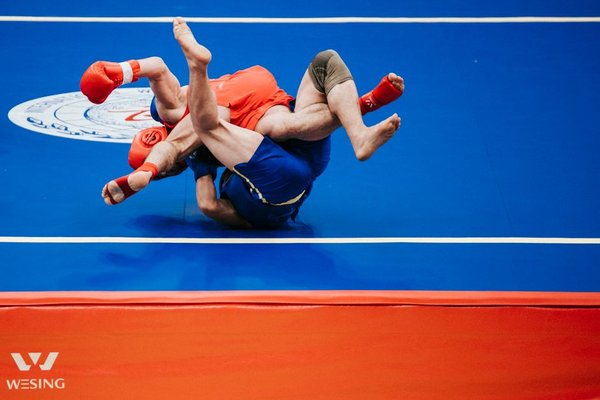
Watch two Olympic wrestling matches back to back and you may notice a striking contrast. In one, an athlete dives for a leg and drives through a takedown. In the other, both competitors fight for chest-to-chest contact before one launches a powerful upper-body throw. That contrast captures the heart of freestyle vs Greco-Roman wrestling: the styles share a scoring system and a goal, but they give athletes different tools to reach it.
The Main Difference at a Glance
Freestyle wrestling allows attacks involving the opponent’s legs, including single-leg takedowns, double-leg takedowns and trips. Greco-Roman wrestling forbids grabbing below the waist and actively using the legs against an opponent. Greco-Roman therefore places much greater emphasis on upper-body grips, body locks and throws.
Both disciplines reward control, exposure of the opponent’s back and decisive attacks. Neither permits striking or submissions. They are Olympic wrestling styles, not separate versions of professional wrestling, and both demand balance, timing, strength and technical precision.
Legal Attacks: Legs Change Everything
What freestyle wrestlers can do
Under freestyle wrestling rules, competitors may attack an opponent’s legs, use their own legs to trip or block, and combine those actions with upper-body techniques. A wrestler might fake a collar tie, change levels and secure a single leg. Another might defend by sprawling, circling behind and taking control.
This range of options forces athletes to protect both upper and lower body. Hand fighting matters, but so do foot positioning, quick level changes and the ability to recover when someone attacks the hips.
What Greco-Roman wrestlers cannot do
Greco-Roman rules prohibit holding below the belt line, tripping and using the legs actively to execute or defend a wrestling action. That does not mean wrestlers stand motionless. They use their feet constantly for movement, balance and driving power; they simply cannot turn a leg into an attacking or defensive tool against the opponent.
Instead, Greco-Roman athletes battle for underhooks, overhooks and body locks. Their attacks may include arm throws, head-and-arm throws and lifts. Legal positioning is critical: an otherwise effective movement can become a foul if the wrestler illegally blocks or engages the opponent with a leg.
Why Their Stances Look Different
Freestyle athletes often wrestle from a lower stance, with bent knees and hips positioned to attack or defend the legs. They change levels frequently, searching for an opening beneath the opponent’s arms. The posture is not identical for every wrestler, but lower-body threats strongly influence it.
Greco-Roman wrestlers generally work more upright because low leg shots are unavailable. They seek upper-body contact, control the opponent’s arms and move their hips into position for a throw. Standing tall does not make Greco-Roman easier: an exposed body lock can quickly become a high-scoring attack.
A useful viewing trick is to watch where each wrestler’s eyes and hands go during the first exchange. Freestyle exchanges frequently threaten the legs; Greco-Roman exchanges concentrate on inside arm position and controlling the torso.
How Scoring Compares
The two styles use the same broad point values. A step-out can earn one point, a controlled takedown or exposure commonly earns two, and more dynamic actions can score four or five depending on how the opponent lands. The precise value depends on the action, not merely how dramatic it looks.
For example, driving an opponent down and gaining control can produce two points in freestyle. In Greco-Roman, an explosive throw that immediately exposes the opponent’s back may be worth four or five. Freestyle also rewards spectacular throws when they meet the relevant criteria; those scores are not exclusive to Greco-Roman.
Both styles can end with a fall, when a wrestler pins both of the opponent’s shoulders to the mat under the rules. Otherwise, points determine the result, subject to the tie-breaking criteria. For a broader explanation of individual actions, Olympic wrestling scoring is a useful companion topic.
Technical superiority is different
One scoreboard distinction is especially easy to remember: a freestyle bout ends by technical superiority at a ten-point lead, while Greco-Roman uses an eight-point lead. Officials allow an ongoing scoring action to finish before confirming the result. A fall can end either type of bout regardless of the score.
Passivity and Ground Wrestling
Both styles penalize inactivity, but not in the same way. In freestyle, officials can designate an inactive wrestler and start a 30-second activity period. If that wrestler fails to score during the period, the opponent receives a point. This encourages meaningful attacks rather than prolonged defensive stalling.
In Greco-Roman, the first two passivity calls in a match award the active wrestler one point and a choice between continuing from standing or starting in par terre, the ground position. Later passivity calls can still bring that positional choice without another automatic passivity point. This makes activity and upper-body positioning central to the match strategy.
Par terre exists in both wrestling styles. In freestyle, a top wrestler might use a gut wrench or leg lace to turn the opponent and score exposures. In Greco-Roman, upper-body holds and lifts are the focus because the restrictions on active leg use remain in force. Those different possibilities shape how athletes defend once they reach the mat.
Which Style Is Harder to Learn?
Neither is universally harder. Freestyle requires defending a wider variety of attacks and developing reliable leg offense. Greco-Roman demands refined upper-body positioning, powerful hand fighting and an understanding of how to create throws without leg attacks.
If you already practise school or collegiate folkstyle wrestling, freestyle may initially feel more familiar because leg takedowns are permitted, although scoring and ground rules differ. Greco-Roman can be an excellent way to improve upper-body awareness and pummeling. For practical skill development, common wrestling takedowns and wrestling stance fundamentals are useful subjects to study alongside either style.
Frequently Asked Questions
Can you grab the legs in Greco-Roman wrestling?
No. Wrestlers may not grip an opponent below the waist or use their legs actively to attack or defend. They can still move their feet and use their legs for ordinary stance, balance and movement.
Are the match lengths the same?
Yes. Senior international bouts in both styles have two three-minute periods separated by a 30-second break. Younger age divisions may wrestle shorter periods under the applicable competition rules.
Can women compete in both Olympic styles?
At the Olympic Games, women compete in freestyle wrestling, while Greco-Roman is contested by men. Women’s freestyle follows the international freestyle framework with a specific additional restriction on the double Nelson hold.
Do Greco-Roman wrestlers score more points for a throw?
Not automatically. A throw’s score depends on its execution and the opponent’s landing position. Both disciplines can award high values for qualifying throws, although upper-body throws appear more central to Greco-Roman tactics.
Final Takeaway
The simplest way to understand freestyle vs Greco-Roman wrestling is to look at what each style permits. Freestyle opens the entire body to legal takedown attacks; Greco-Roman concentrates the contest above the waist. From that single rule difference come distinct stances, combinations, defenses and match rhythms. Learn to recognize the permitted grips and the scoring suddenly becomes much easier to follow.